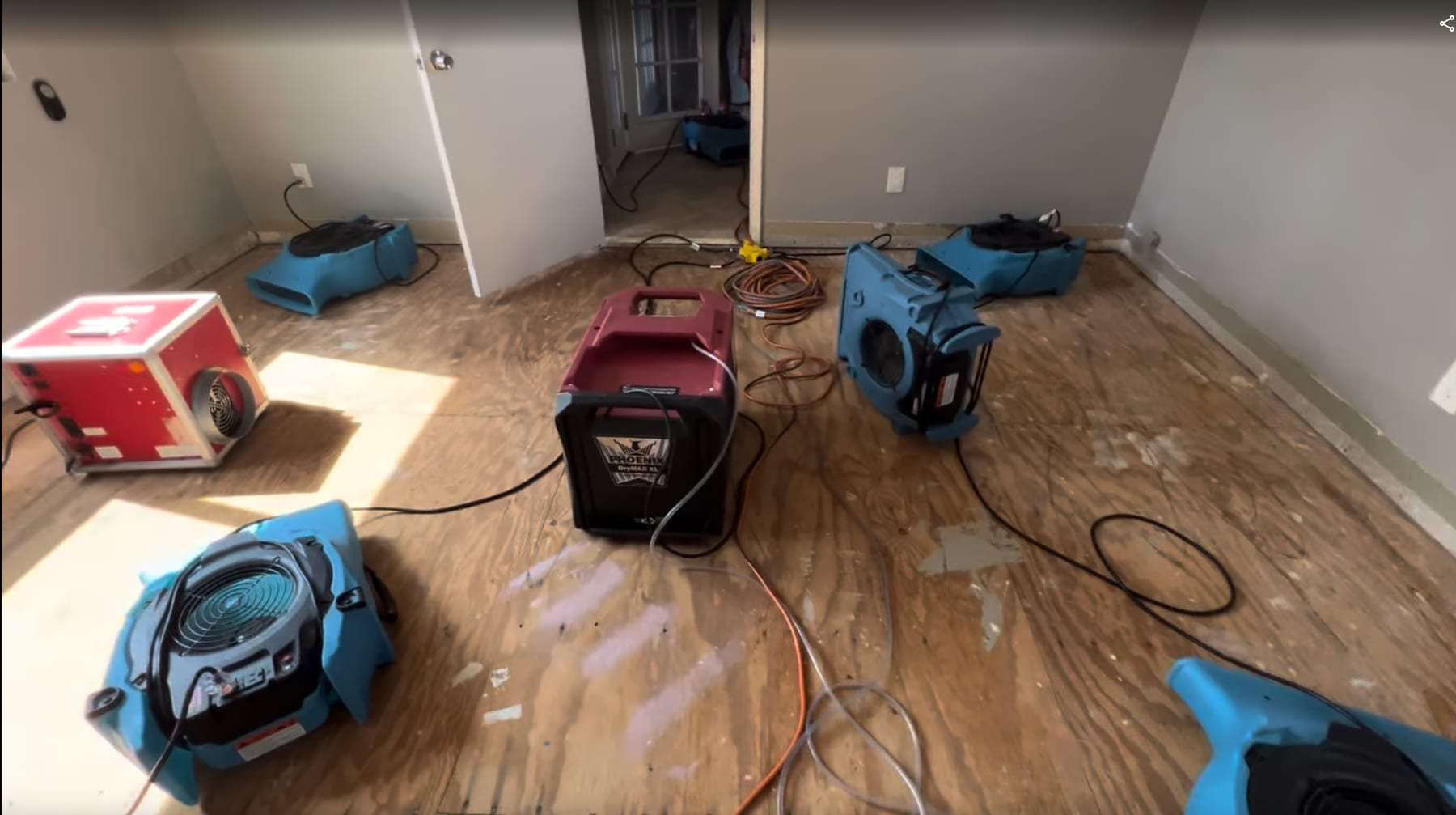
Bedroom with the flooring removed and the subfloor drying under air movers. Illustrative only: this photo is not from a job tied to this site or a specific address.
The situation
Illustrative example. Not a real job or customer.
In a hypothetical eight-story condo building, the parking garage has a row of chain-link storage lockers along one wall. During a multi-day arctic cold snap, the overhead garage door is stuck partly open after a resident's car clips the sensor. A sprinkler branch near the door freezes. Two days later, as temperatures rise, the ice melts and water sprays from a split fitting onto the lockers and floor below. The fire alarm activates.
- Residents evacuate per the alarm. The fire department arrives, confirms there is no fire, and building staff work with the fire protection contractor to shut down that section of the system.
- The manager arranges a fire watch as required while the system is impaired, posts a notice, and calls the association's restoration vendor and master carrier.
- Staff photograph the garage, the split fitting and every locker before anything is moved, and email owners with lockers in the affected row.
- Owners are asked to remove or inspect their stored items within a set window, with staff providing access.
- The restoration firm extracts water from the floor, sets drying equipment along the wall, and checks the adjacent stairwell and elevator lobby.
- The fire protection contractor repairs the fitting and returns the system to service; the garage door is repaired.
The building damage is limited to the garage floor, a drywall stairwell wall and some electrical fixtures that are inspected and cleared. Several owners find that boxed documents and holiday decorations in cardboard were ruined. Those items fall under each owner's own policy, not the master policy.
The lesson about the garage door
The root of this example is a garage door left partly open during extreme cold. Many sprinkler systems in parking structures are designed for freezing conditions, but branches near doors and openings can still be exposed to colder air than intended. A door that sticks open for hours or days can change that. Reporting a stuck door immediately, rather than assuming someone else will, is one of the simplest prevention steps residents can take.
Storage is the other lesson. Cardboard boxes on a garage floor wick water quickly. Plastic bins with lids, kept on shelving off the floor, would have protected most of what was lost.
If your locker is in the affected row
- IfItems are in cardboard and wetThenPhotograph them in place, then move salvageable items to dry space. Ask your insurer before discarding anything of value.
- IfDocuments or photographs are wetThenFreeze them in sealed bags if you cannot dry them within a day or two.
- IfYou are travelingThenAsk staff or a neighbor to photograph and move items for you, with written permission.
- IfItems are in sealed plastic bins on shelvesThenWipe the outsides, check inside for moisture, and let them air out before closing them up again.
General information for Cherry Creek, not a quote or professional advice. In an emergency, call 911.