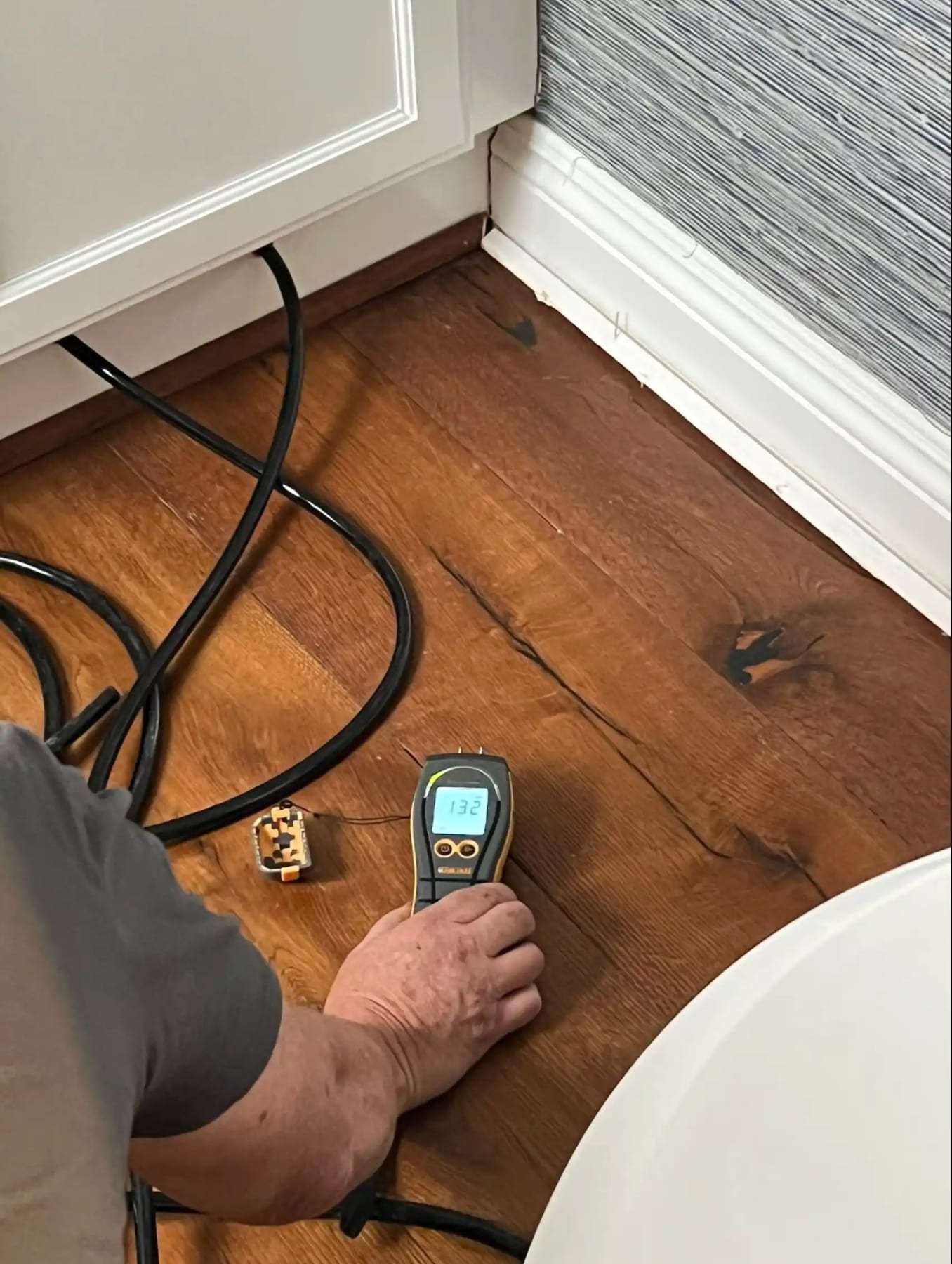
Hand holding a moisture meter on a hardwood floor. A general example of this kind of work, not a photo of a particular home, business or job.
How premium floors respond to water
| Floor | What water does | Drying notes |
|---|---|---|
| Site-finished wide-plank oak | Boards swell across their width and cup, with edges higher than centers. Wider boards cup more visibly. | Often recoverable if drying starts early. Specialized floor-drying mats can pull moisture up through the boards. Refinishing usually follows. |
| Engineered wide plank | The thin wear layer can delaminate from the core if soaked for long. | Drying in place is sometimes possible; delaminated boards generally need replacement. |
| Marble, limestone and travertine | The stone itself tolerates water, but it is porous and can stain from minerals or dirty water. Grout and setting materials can trap moisture. | Surface drying is quick; the substrate under the stone may stay wet much longer. Staining sometimes appears after drying. |
| Porcelain tile | Largely unaffected on the surface; water moves through grout joints to the subfloor. | Check the subfloor and any wood framing underneath with a meter. |
| Radiant heat under any floor | Water around tubing or electric mats is not usually harmful to the system, but a leak in hydronic tubing can be the cause. | Have the radiant system checked before turning it on to speed drying. |
Why patience pays with these floors
Cupped oak often flattens on its own as it dries. If a floor is sanded while it is still cupped, the high edges are cut down, and when the boards finish drying they can crown, leaving the centers higher than the edges. Many flooring professionals recommend waiting until moisture readings in the boards and subfloor are back near normal before deciding whether to sand, refinish or replace.
Matching is the other concern. Wide-plank oak with a custom stain, or a particular lot of marble, may be difficult to match exactly. Replacing a section can leave a visible patch, which is why insurers and owners sometimes disagree about how much of a continuous floor should be replaced. Photographs taken before the loss, receipts, and the product name or quarry source are all useful here.
Radiant floors add one more step. If the leak came from hydronic tubing, the system has to be repaired and pressure-tested by someone who works on those systems. If the radiant system is fine, using it gently can help drying, but only after someone confirms it is safe to run.
Common decision points
- IfOak boards are cupped but firmly attachedThenAsk for a drying plan with daily board and subfloor readings before anyone talks about sanding or replacement.
- IfEngineered boards are bubbling or the top layer is separatingThenThose boards are unlikely to recover. Ask whether removing only the damaged section will leave a visible seam, and document the rest.
- IfStone looks dry but grout lines stay darkThenMoisture is still in the setting bed or subfloor. Ask for readings at the grout and from below if there is access.
- IfThe leak may have come from the radiant tubing itselfThenStop using the system and have it pressure-tested before drying is considered finished.
- IfThe insurer proposes replacing only part of a continuous floorThenAsk how a match will be achieved, and provide original product details and photos so the question can be judged fairly.
General information for Cherry Creek, not a quote or professional advice. In an emergency, call 911.